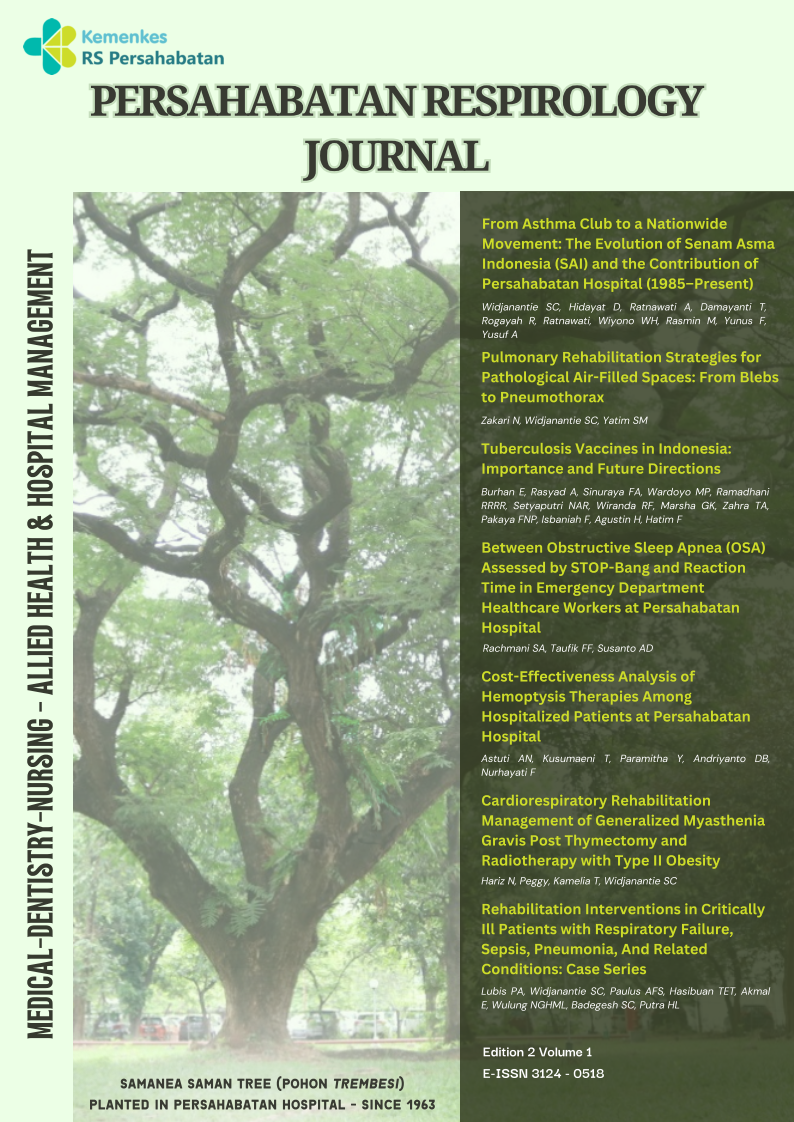
Early Rehabilitation in adult and paediatric critically ill patients with respiratory failure, sepsis, and pneumonia: Case series
DOI:
https://doi.org/10.67483/prj.v2.i1.24Keywords:
Intensive care rehabilitation, progressive mobilization, ventilator weaning, functional recoveryAbstract
Background: Critically ill patients with acute respiratory failure,sepsis, pneumonia,and complex comorbidities frequently develop prolonged ventilator dependence,impaired airway clearance, intensive care unit-acquired weakness (ICU-AW), anda high risk oof post-intensive care syndrome (PICS). Early, structured rehabilitationthat integrates respiratory support, neuromuscular preservation, and mobilizationmay improve recovery.
Case: This case series describes three patients treated in the adult ICU andpediatric ICU of Persahabatan General Hospital's who received individualizedintensive rehabilitation. A young adult with obesity, type 2 diabetes and sepsis; amiddle-aged adult with severe community-acquired pneumonia and prolongedmechanical ventilation; and a preschool child with status epilepticus, sepsis, andbronchopneumonia. Functional status was evaluated using ICU Mobility Scale(IMS), Chelsea Critical Care Physical Assessment Tool (CPAx), Medical ResearchCouncil Sum Score (MRC-SS), Functional Status Scale (FSS), and grip strength.After 2 weeks, case 1 showed IMS improving from 0 to 6, CPAx from 2 to 27, andMRC-SS from 40 to 60, alongside successful ventilator weaning. After 3 weeks,case 2 showed CPAx improving from 5 to 20, IMS from 1 to 4, MRC-SS from 24to 32, grip strength from 5.2 to 11.3 kg in both arms, and cough flow from 45 to 79L/min. Case 3 showed FSS improving from 23/36 to 16/36 and IMS from 0 to 6after 3 weeks.
Discussion: These cases illustrate the feasibility of early multimodal rehabilitationin medically complex ICU/PICU patients. The combination of positioning,progressive mobilization, airway clearance techniques, Neuro-Muscular ElectricalStimulation (NMES), and caregiver engagement was associated with meaningfulgains in functional recovery.
Conclusion: A structured, multidisciplinary rehabilitation program may supportventilator liberation and functional improvement in critically ill patients across awide age range. Larger prospective studies are needed to define optimal protocolsand long-term outcomes.
Downloads
Published
Issue
Section
License
Copyright (c) 2026 Putri Alfaridy Lubis, Siti Chandra Widjanantie,, Anitta Florence S. Paulus, Thariq E. T. Hasibuan, Ernita Akmal, Navy G. H. M. Lolong Wulung, Saad Chalid Badegesh, Hening Laswati Putra (Author)

This work is licensed under a Creative Commons Attribution-NonCommercial-ShareAlike 4.0 International License.